
The Snoqualmie River crested at 54.3 feet during the January 2009 floods — nearly 20 feet above flood stage. For homeowners watching muddy water recede from their living rooms, the immediate damage was obvious. What they couldn't see was the hidden enemy that would emerge in the following weeks: toxic mold growth that would threaten their families' health and their homes' structural integrity.
Living in the Snoqualmie Valley means accepting certain environmental realities. The region's unique geography creates a perfect storm for mold development: river flooding, persistent winter moisture, dense forest canopy that blocks sunlight, and homes built on flood-prone soil. Understanding these risks isn't about fear — it's about protection.
Mold in Snoqualmie Valley
Mold in Snoqualmie Valley homes develops faster and spreads more aggressively than in most other Washington regions. The valley's microclimate combines high humidity levels with temperature fluctuations that create ideal conditions for spore germination.
The Snoqualmie River system influences moisture levels year-round, not just during flood events. Groundwater saturation affects foundation moisture, while the river's proximity keeps ambient humidity elevated. During winter months, humidity levels regularly exceed 80% — well above the 60% threshold where mold growth accelerates.
“In our 20 years serving the Snoqualmie Valley, we've completed over 1,000 restoration projects, and mold remediation represents nearly 40% of our winter emergency calls.”
Key Takeaway
Valley homes face triple the mold risk of Seattle-area properties due to river proximity, elevation, and seasonal flooding patterns.
Snoqualmie Valley Mold Prevention
Effective mold prevention in the Snoqualmie Valley requires understanding the unique environmental pressures your home faces. Traditional prevention strategies often fall short because they don't account for the valley's specific moisture sources.
Crawl space management becomes critical when your home sits on flood-prone soil. Vapor barriers must be industrial-grade and properly sealed. Standard 6-mil plastic sheeting fails within two years under valley conditions. We recommend 12-mil reinforced barriers with sealed seams and proper drainage systems.
Foundation waterproofing needs regular inspection. Hydrostatic pressure from saturated soil creates micro-cracks that allow moisture infiltration. These small openings become mold highways, spreading contamination throughout your home's structure.
Seasonal Risk Patterns Near You
Valley mold follows predictable seasonal patterns that smart homeowners monitor closely:
Initial Moisture Buildup
Moderate risk
Peak Mold Season
High risk
Secondary Growth Surge
Elevated risk
Maintenance Window
Lower risk
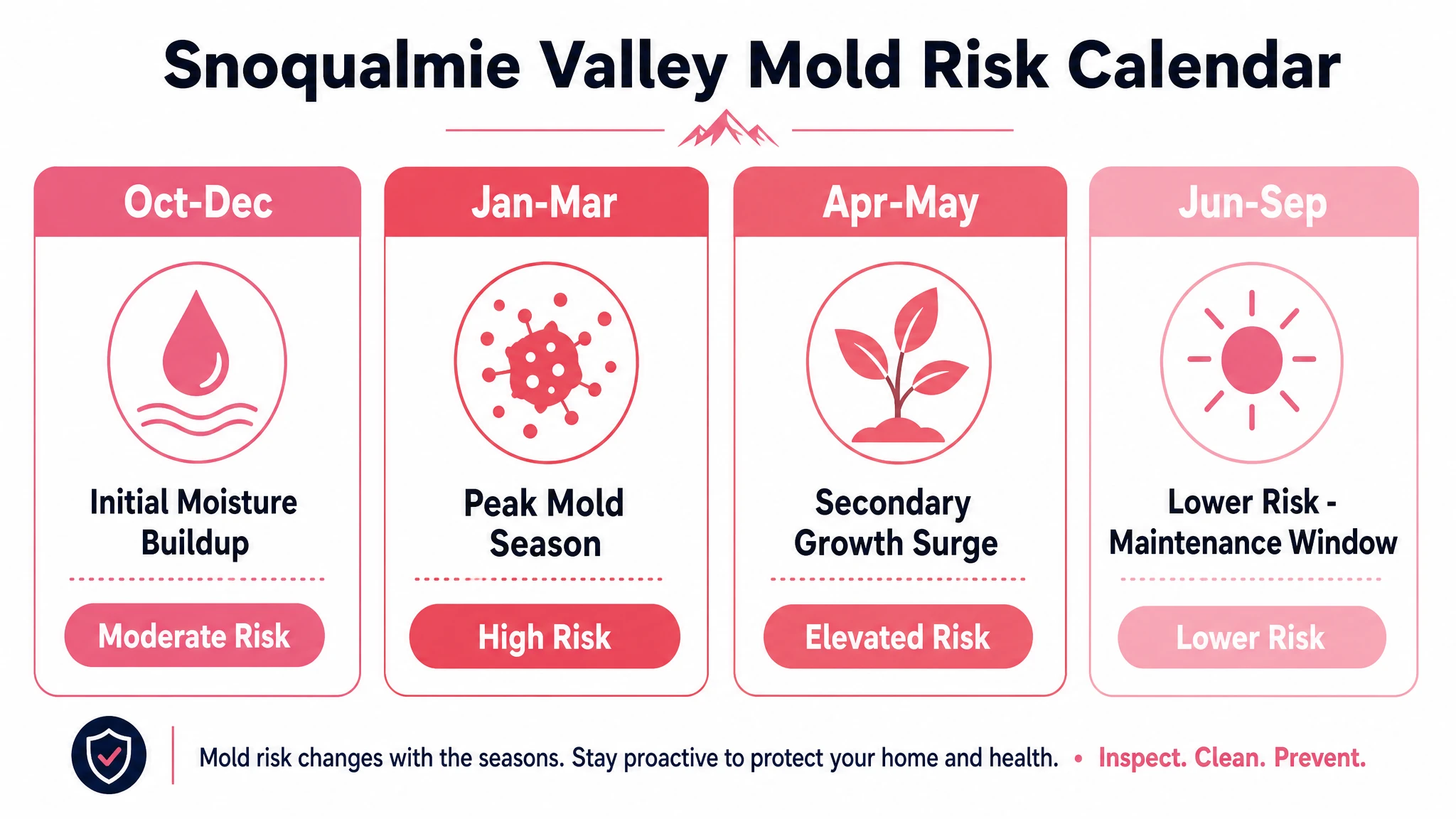
Seasonal mold risk patterns in the Snoqualmie Valley
River Flooding and Mold Amplification
When the Snoqualmie River floods, it doesn't just bring water — it brings contaminated sediment loaded with organic matter that feeds mold growth. Floodwater carries agricultural runoff, decaying vegetation, and soil microorganisms that accelerate contamination.
According to the King County Flood Control District, properties within the 100-year floodplain experience some level of water intrusion every 3-5 years on average. Each incident creates new mold risk, even when flooding seems minor. If your home has experienced river flood damage, professional assessment is essential.
Health Impacts Specific to Valley Residents
Valley residents face compounded health risks because outdoor mold spore counts remain elevated year-round due to forest density and river moisture. When indoor mold develops, it creates a double exposure scenario that overwhelms immune systems faster than typical urban environments.
Respiratory symptoms appear within days rather than weeks in valley homes with mold problems. The high baseline spore count means any additional indoor exposure quickly exceeds safe thresholds.
Allergic reactions intensify because residents already experience seasonal sensitivity to outdoor molds. Indoor contamination compounds these effects, creating year-round symptoms that many residents mistakenly attribute to “valley allergies.”
Vulnerable Populations in Rural Settings
Valley families often include multiple vulnerable individuals under one roof. Children, elderly relatives, and family members with asthma or compromised immune systems face heightened risks in rural settings where medical care requires longer travel times.
73%
of valley mold cases involve children under 12 experiencing respiratory symptoms
Property Damage Patterns in Valley Homes
Mold damage in Snoqualmie Valley homes follows distinct patterns that differ from urban properties. Understanding these patterns helps homeowners identify problems before they become catastrophic.
Structural damage accelerates in valley homes because moisture cycles are more extreme. Wet seasons saturate building materials, while dry periods cause expansion and contraction that creates new entry points for future moisture.
HVAC system contamination spreads faster in valley homes due to higher humidity loads. Ductwork condensation provides ideal growing conditions, and contaminated systems distribute spores throughout the entire home.
Hardwood and Flooring Vulnerabilities
Valley homes with hardwood flooring face unique challenges. Seasonal moisture fluctuations cause wood expansion that creates gaps where spores accumulate. Traditional refinishing schedules prove inadequate under valley conditions. Learn more about specialized drying for hardwood floors.
Laminate and engineered flooring perform better than solid hardwood, but installation quality becomes critical. Improper moisture barriers fail quickly, allowing subfloor contamination that requires complete replacement.
Insulation and Drywall Concerns
Valley homes built before 1990 often use insulation materials that retain moisture longer than modern alternatives. Fiberglass batts become mold reservoirs, while blown-in cellulose creates hidden contamination pockets.
Drywall moisture content regularly exceeds safe levels during winter months. Paper backing provides ideal food sources for mold growth, and contamination spreads behind walls where it remains undetected for months.
Early Detection Strategies for Valley Homeowners
Early detection saves valley homeowners thousands in remediation costs and protects family health. Professional leak detection and inspection identifies problems before they become visible, but homeowners can monitor key indicators between professional visits.
Moisture meter readings provide objective data about hidden moisture levels. Wood moisture content above 19% indicates elevated mold risk, while drywall readings above 1% suggest active moisture intrusion.
Air quality monitoring reveals spore count changes that precede visible growth. Baseline testing during dry seasons establishes normal levels, making abnormal readings easier to identify.
Visual Inspection Checklist
Valley homeowners should inspect specific areas monthly, focusing on moisture-prone locations:
- ✓Crawl space corners where groundwater seepage occurs
- ✓Window sills facing the river or forested areas
- ✓Bathroom exhaust fan housings and ductwork
- ✓Basement walls below grade level
- ✓Attic areas where roof moisture penetrates
Technology-Assisted Detection
Modern detection tools help valley residents stay ahead of mold problems. Wireless humidity sensors provide real-time data about moisture levels in critical areas. Smart home systems can alert homeowners when conditions favor mold development.
Thermal imaging cameras reveal moisture patterns invisible to naked eye inspection. These tools identify problem areas before mold becomes visible, allowing preventive action rather than reactive remediation.
Professional Remediation vs. DIY Approaches
Valley mold problems require professional remediation because contamination spreads differently in high-moisture environments. DIY approaches that work in dry climates often fail under valley conditions, creating larger problems and health risks.
Containment challenges multiply in valley homes where ambient humidity prevents proper drying. Professional equipment maintains controlled environments during remediation, while DIY efforts often spread contamination to previously clean areas.
Source elimination requires identifying and correcting moisture sources that may be complex and interconnected. Valley homes often have multiple moisture entry points that require coordinated solutions.
“Thank you Aaron for everything you and your company did to fix my water leak problems. You are clearly a cut above.”
— James Clague, verified customer review
Professional Equipment Requirements
Valley remediation requires specialized equipment designed for high-humidity environments. Industrial dehumidifiers, negative air machines, and HEPA filtration systems must operate continuously during treatment periods.
Professional teams use moisture mapping technology to identify all affected areas, including hidden contamination behind walls and under flooring. This comprehensive approach prevents recontamination from missed sources.
Timing and Seasonal Considerations
Remediation timing affects success rates in valley environments. Winter remediation requires extended drying periods and climate control. Summer work allows faster completion but must account for increased outdoor spore counts.
Professional teams schedule work during optimal weather windows and maintain controlled environments regardless of external conditions. This expertise proves critical for valley projects where environmental factors change rapidly.
Insurance and Financial Considerations
Valley homeowners face unique insurance challenges related to mold coverage. Flood-related mold may fall under different policy sections than moisture-related growth, creating coverage gaps that require careful navigation. Our claims concierge service can help.
Documentation requirements become critical for valley claims because insurers scrutinize flood-related damage more carefully. Professional documentation establishes timelines and causation that support coverage decisions. Learn more about what insurance won't tell you about water claims.
Preventive maintenance records demonstrate responsible homeownership and may influence coverage decisions. Regular inspections, maintenance receipts, and moisture monitoring data strengthen insurance positions.
Cost-Benefit Analysis of Prevention
Prevention costs in valley homes typically run $500-2,000 annually for comprehensive moisture management. Remediation costs range from $3,000-15,000 for moderate contamination, with extensive damage reaching $25,000 or more.
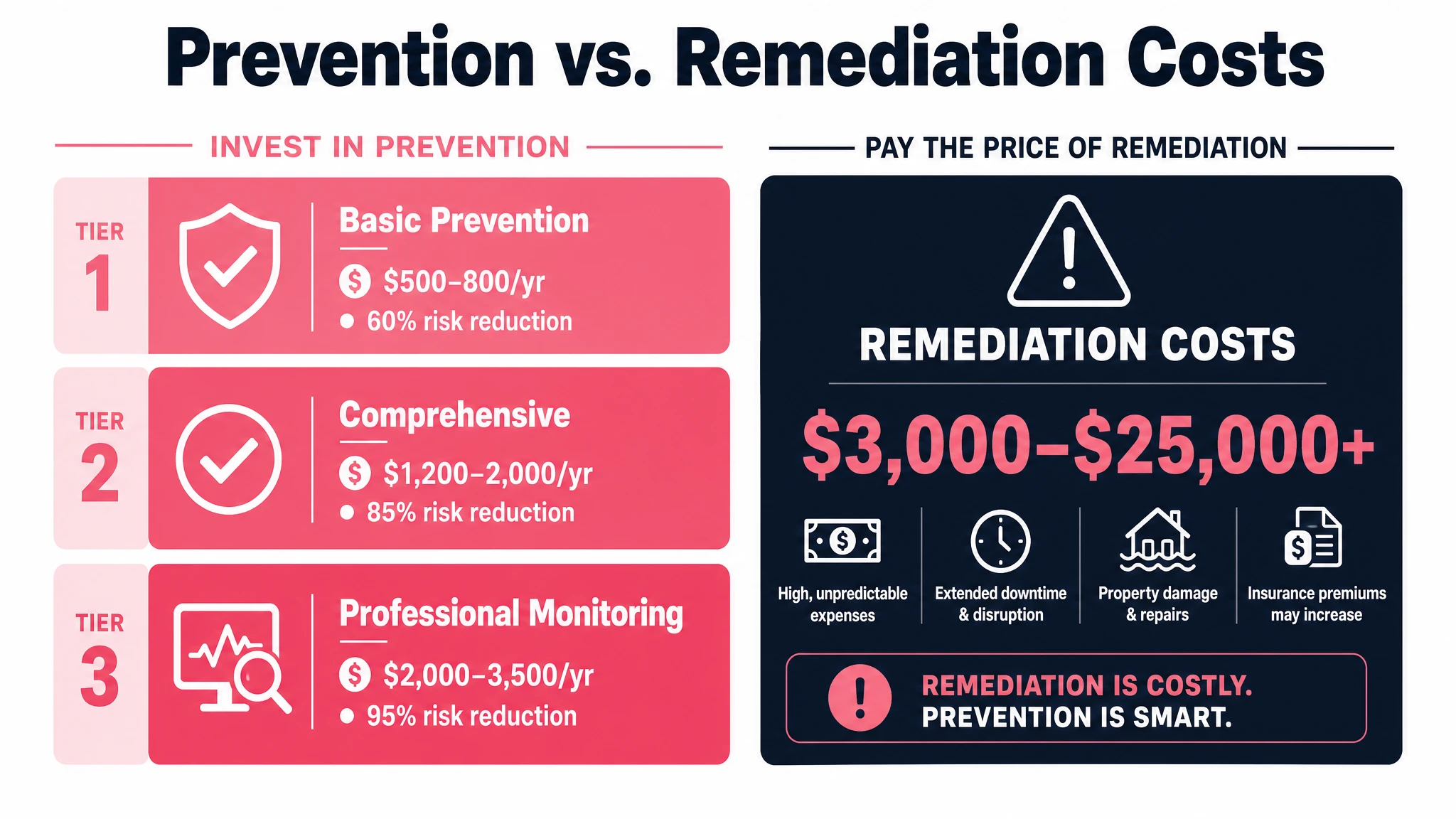
Prevention is significantly more cost-effective than remediation
| Intervention Level | Annual Cost | Effectiveness | ROI Timeline |
|---|---|---|---|
| Basic Prevention | $500–800 | 60% risk reduction | 2–3 years |
| Comprehensive Management | $1,200–2,000 | 85% risk reduction | 3–5 years |
| Professional Monitoring | $2,000–3,500 | 95% risk reduction | 5–7 years |
Why Choose BestDry for Snoqualmie Valley Mold Issues
BestDry understands valley-specific mold challenges because we've served this community for over 20 years. Our team has completed more than 1,000 restoration projects throughout King, Snohomish, and Pierce Counties, with extensive experience in flood-prone areas.
As members of PHCC Washington, we maintain current certifications and follow industry best practices adapted for Pacific Northwest conditions. Our 5.0-star rating from 39 verified reviews reflects our commitment to quality work and customer satisfaction.
Local Expertise and Valley Knowledge
Our team knows the Snoqualmie Valley's unique challenges firsthand. We understand seasonal patterns, common problem areas, and effective solutions that work under local conditions. This knowledge translates to faster diagnosis, more effective treatment, and longer-lasting results.
We maintain relationships with local contractors, suppliers, and insurance professionals who understand valley-specific issues. This network ensures comprehensive solutions and smooth project coordination.
Emergency Response and Availability
Valley emergencies require immediate response because environmental conditions accelerate damage progression. Our 24/7 emergency service ensures rapid response when mold problems threaten your family's health or your property's value.
We stock valley-appropriate equipment and materials, reducing response times and ensuring effective treatment from the first visit. Our emergency protocols prioritize health and safety while minimizing property damage.
Don't let Snoqualmie Valley's unique environmental challenges compromise your family's health or your home's value. Contact BestDry today for comprehensive mold assessment and professional remediation services designed specifically for valley conditions.